
Did you dream last night? Yes, of course you did. You just can’t remember.
Scientific research confirms that every human being dreams. In fact, you spend roughly two hours of every night in REM (Rapid Eye Movement) sleep, creating vivid, complex narratives. Yet, the vast majority of people wake up believing they saw nothing but blackness.
This is not a failure of imagination. It is a failure of memory encoding.
If you are trying to learn Lucid Dreaming, this is your first and most critical hurdle. You cannot become aware inside a dream if you cannot even remember that the dream happened. It would be like writing a masterpiece novel every night, only to burn the pages the moment the sun comes up.
This guide is not about keeping a sentimental “Dear Diary.” It is a technical manual for hacking your brain’s short-term memory system. We will bypass the biological mechanism that wipes your memory and train your brain to treat dreams as valuable data, not junk files. I have multiple years of experience in dream journaling and remembering dreams. Within those years, I’ve come across a lot of great advice on how to improve recall. This is how you will, too!
The Neuroscience: Why We Forget Dreams Instantly?
To solve the problem, we first need to understand the hardware glitch. Why does the brain aggressively erase dreams within seconds of waking up?
The answer lies in the neurochemistry of the Hippocampus, the part of the brain responsible for moving information from short-term memory (RAM) to long-term storage (Hard Drive).
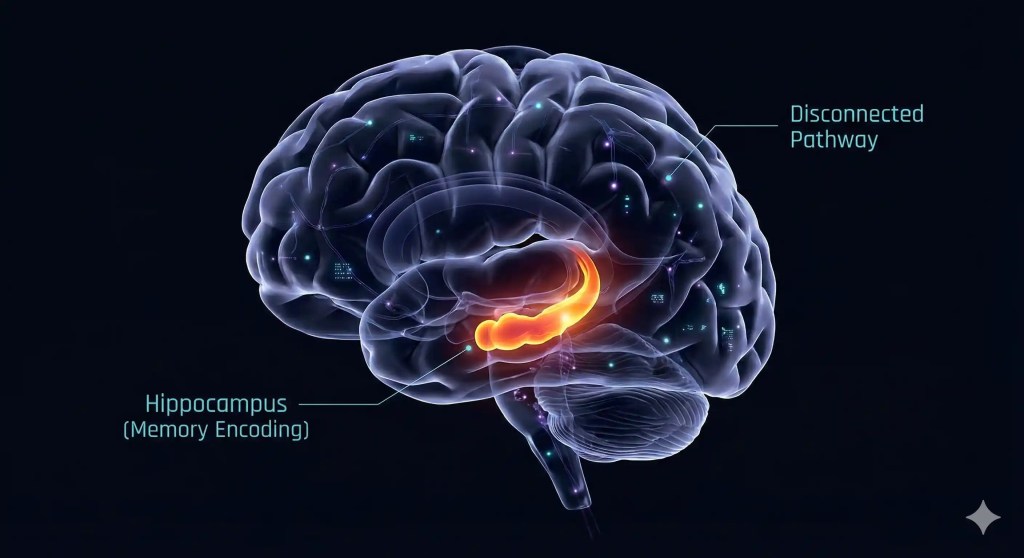
The Neurochemical Washout
When you are asleep, your brain is flooded with Acetylcholine (which drives focus and brain activation) but has almost zero Noradrenaline (which is essential for memory formation).
Research confirms that the Locus Coeruleus—the part of the brain responsible for producing noradrenaline—completely stops firing during REM sleep. A study published in Behavioral and Brain Sciences highlights that without this neurochemical, your brain physically cannot consolidate short-term memories into long-term storage source.
This creates a paradox: Your brain is hyper-active and experiencing vivid hallucinations (dreams), but the “Save Button” is chemically disabled.
Importantly, this delicate chemical balance relies on stable REM cycles. If you suffer from fragmented rest, the brain prioritizes metabolic recovery over memory encoding. This is why optimizing your sleep quality is the foundational step before attempting advanced recall techniques.
The Golden Rule: The Don’t Move Protocol
The moment you wake up is the most critical point for dream recall. You are entering the Hypnopompic State—a fragile 60–90 second window where your brain transitions from sleeping to waking.
Most beginners make a fatal mistake here: they turn off the alarm, stretch, or open their eyes to look at the time. Even worse, most people instantly grab their phone, which is the biggest mistake of them all.
Do not move a muscle.
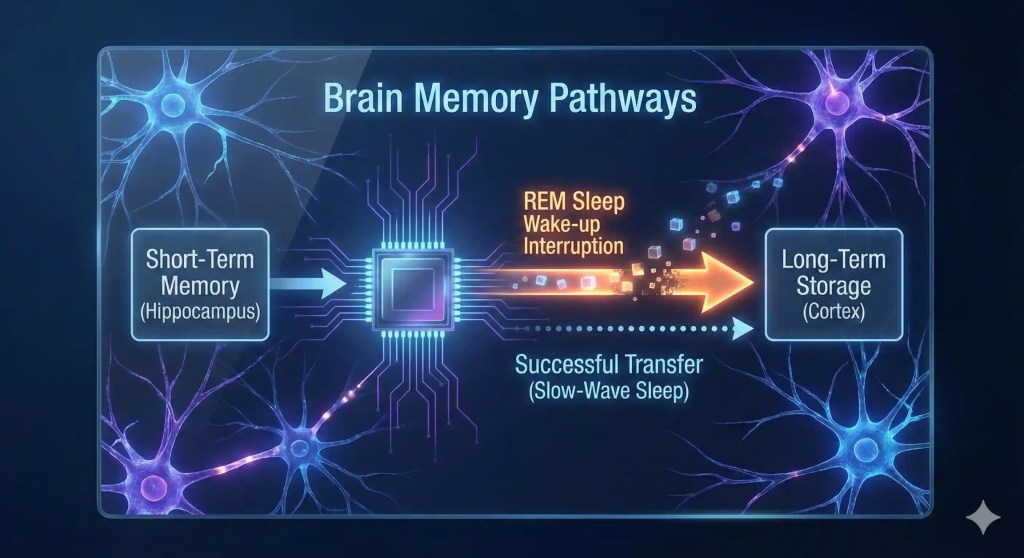
Sensory Overwrite
Why is movement so destructive? Your brain has limited bandwidth. When you move your physical body, your brain immediately shifts its priority from internal processing (memories) to external processing (sensory input).
The sensation of your sheets, the light in the room, and the sound of the alarm create a massive spike in sensory data. This new data overwrites the faint electrical signals of your dream memory. It is equivalent to closing a Word document without saving it.
The 90-Second Drift
Instead of moving, adopt the ‘Play Dead’ strategy. This is the single most effective thing you can do when starting from zero, and it has helped me rebuild my dream recall multiple times after losing it during breaks from journaling. If you feel like you never remember your dreams, this is where you should start.
- Keep your eyes closed. Visual input is the strongest memory eraser.
- Stay completely still. Do not even shift your position.
- Ask yourself: “What was I just doing?”
- Work backwards. Don’t try to remember the whole story. Find one fragment—a face, a color, a feeling. Once you grab that fragment, the rest of the narrative will often pull itself out of the subconscious like a chain.
The Collection Method: Journaling Like a Scientist
The biggest enemy of dream journaling is friction. If recording your dream feels like a chore, you will stop doing it.
Traditionally, people are told to keep a pen and notebook by the bed. While effective, turning on a light to write legible sentences can jolt your brain fully awake, making it impossible to fall back asleep for a second dream cycle.
Audio Logs > Written Text
For the modern lucid dreamer, voice memos are a very solid option to consider. This is the laziest way of dream journaling, but there’s nothing wrong with that!
- Speed: You can speak 150 words per minute but only write 20. You can capture a complex narrative in seconds before it fades.
- Darkness: You don’t need to turn on the lights.
- Emotion: Audio captures the tone of the dream (fear, excitement) which text often misses.
The Tagging Technique
Do not try to narrate the entire story immediately. Your memory works associatively. If you try to tell the story chronologically from the start, you might forget the ending while speaking.
Instead, use Tagging:
- Grab your phone (keep the brightness at the lowest setting).
- Quickly whisper 3–5 keywords that anchor the main scenes.
- Example: “Red car. Underwater breathing. Giant cat.”
- Once these “anchors” are safe, go back and fill in the details.
Pro Tip: If you must use your phone screen, ensure you have a blue light filter enabled. Exposure to blue light suppresses melatonin and can ruin your ability to re-enter REM sleep.
Optimizing Biology: The Role of Sleep Cycles
You can follow every protocol perfectly, but if you wake up at the wrong biological moment, your efforts will fail.
Sleep is not a uniform block of time; it is a series of 90-minute cycles. These cycles consist of NREM (Deep Sleep) and REM (Dream Sleep).
- Waking up during NREM: Your brain is in repair mode. Research published in JAMA has shown that waking up during deep sleep causes severe cognitive impairment—known as sleep inertia—that can be as detrimental to brain function as alcohol intoxication source. In this state, memory recall is virtually impossible.
- Waking up during REM: Your brain is as active as it is when you are awake. Waking up here is like pausing a movie; the scene is fresh, vivid, and easy to recall.
The Alarm Shock Factor
Traditional loud alarms are dream killers. A sudden, blaring noise triggers a cortisol spike (fight-or-flight response). Your brain immediately prioritizes survival over memory retention, and the dream evaporates.
To maximize recall, you need to wake up gently, preferably at the end of a REM cycle.
- Use a Smart Alarm: Apps like Sleep Cycle track your movement and wake you when you are in a light sleep phase.
- Vibration Only: If possible, use a vibrating wrist alarm. It wakes the body without shocking the auditory cortex.
The Foundation: Quality over Quantity
Finally, remember that dream recall is a luxury function of the brain. If you are sleep-deprived, your body will prioritize Deep Sleep (physical recovery) and shorten your REM stages.
You cannot recall what you didn’t experience. To have long, vivid dreams to remember, you must first ensure your sleep architecture is healthy. If you struggle with broken sleep or insomnia, read our guide on how to optimize your sleep quality first. Without that foundation, advanced recall techniques are useless.
Troubleshooting: Breaking the “Dry Spell”
If you follow the Don’t Move protocol and still wake up with a blank mind, your brain has likely deprioritized dreaming due to stress or lack of interest. You need to manually override this setting.
1. The “Intention” Hack
This is not about “wishing” to remember. It is about prospective memory—the same mechanism that allows you to wake up at 6:00 AM just before your alarm rings because you have an early flight.
Your brain can execute commands while you sleep, but only if the command is clear.
- The Protocol: Before you fall asleep, repeat a mantra: “When I wake up, I will remember my dreams.”
- The Key: Do not just say the words. Visualize yourself waking up, reaching for your phone, and recording a dream. You are training the neural pathway before you need to use it.
2. Chemistry Support (Vitamin B6)
If psychology fails, adjust the chemistry.
- Vitamin B6: Research suggests that Vitamin B6 (Pyroxidine) increases the vividness of dreams by converting Tryptophan into Serotonin.
- Dose: 100mg–240mg before bed.
- Warning: Do not rely on Galantamine yet. It is a heavy-duty lucid dreaming supplement. If you can’t recall regular dreams, Galantamine is like putting jet fuel in a broken engine. Fix the engine first.
3. The Cortisol Block
Stress is the number one killer of dream recall. High cortisol levels cause fragmented sleep and suppress REM cycles. If you are stressed, your brain focuses on survival, not introspection.
- The Fix: If you have a “dry spell” (weeks without recall), stop trying so hard. The stress of failing to remember is likely causing the block. Take a week off, fix your sleep schedule, and try again.
Conclusion: Recall is the First Step to Lucidity
Dream recall is not a mystical gift. It is a mechanical skill, like riding a bike or typing. If you follow the “Don’t Move” protocol and prioritize your sleep hygiene, your brain will adapt. It has no choice.
Expect results within 3 to 7 days. At first, you will catch fragments. Then, full scenes. Eventually, you will wake up with multiple detailed narratives every morning.
Why does this matter?
You cannot control what you do not perceive. Once you start recording your dreams, you will notice repeating patterns—strange locations, recurring characters, or laws of physics that don’t make sense.
These are your Dream Signs. They are the glitches in the matrix that will eventually allow you to wake up inside the dream. In the next guide, we will teach you how to spot these signs and use them to trigger lucidity.
Take the next step: The Ultimate Guide to Reality Checks: How to Wake Up Inside a Dream
Master Your Sleep and Dreaming – best resources
🎧 What to read next?
If you want to master sleep and dreaming, I recommend starting with the these books. (Transparency: This section contains affiliate links to tools I personally use and trust.)
- Why We Sleep, Surely the greatest book about sleep!
- Exploring the World of Lucid Dreaming, Bible of Lucid Dreaming!
- Lucid Dreaming: Gateway to the Inner Self, To become the Lucid Master!
Tip: You can currently get all of these books via this Audible deal (3 months for $0.99/month). It’s almost free too!
✨ The Best Silk Pillowcases and sheets!
- Promeed Official Store: To minimize sensory disturbances during the night, your physical environment must be optimized. Promeed offers premium 6A+ Mulberry silk bedding designed to regulate temperature and reduce friction, ensuring your REM sleep remains as deep and uninterrupted as possible.



 Likely Dreaming | Exploring Dreams & Sleep
Leave a comment