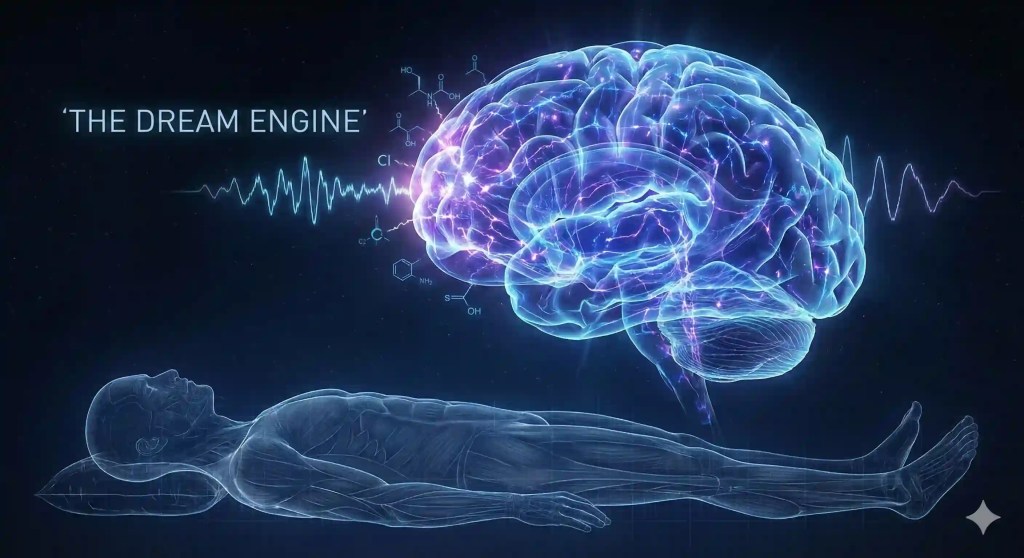
Why don’t your dreams make sense?
REM (Rapid Eye Movement) sleep is the biological foundation of all dreaming, particularly lucid dreaming. While other sleep stages focus on physical recovery, REM is a high-energy cognitive state.
To master lucidity, you must understand the mechanics of the ‘dream engine’—how it starts, how it functions, and why it is the primary—but not the only—state where conscious awareness can surface during sleep.
What Happens During REM? The Biological Blueprint
It wasn’t until 1953 that Aserinsky and Kleitman discovered REM sleep, revealing that the brain is far from quiet during the night. In fact, your brain is almost as active as it is when you are wide awake.
Brain Activity: Paradoxical Sleep
REM is often called “paradoxical sleep” because your brain waves (recorded via EEG) show low-voltage, desynchronized patterns similar to a waking state. Your brain consumes significant amounts of oxygen and glucose during this stage.
- The Implication for Lucidity: Because the brain is already functioning at a high metabolic rate, the “jump” to conscious awareness (lucidity) requires less energy than it would in deeper, slower sleep stages.
Muscle Atonia: The Body’s Safety Switch
One of the most critical markers of REM sleep is postural muscle atonia. The brain sends signals down the spinal cord to effectively paralyze your voluntary muscles.
- The Purpose: This prevents you from physically acting out your dreams, which could lead to injury.
- The Lucid Connection: This state of paralysis is the root of “Sleep Paralysis.” For a lucid dreamer, understanding that atonia is a natural sign of REM sleep is the key to turning a frightening waking-paralysis episode into a direct entry into a lucid dream (the WILD technique).
Rapid Eye Movement: Scanning the Dreamscape
The namesake of this stage—rapid eye movements—occurs when the brain sends signals to the eye muscles. Research suggests these movements often correspond to where the dreamer is “looking” within the dream world. This confirms that the brain treats dream visuals as real sensory data.
So, if you open the eyelid of a friend who has fallen asleep and see their eye spinning like crazy, don’t get scared. They are just in REM sleep. Wait, actually—what are you doing? Close the lid and let them sleep.
The Neurochemistry of the Dream State
The transition into REM sleep is governed by a radical shift in your brain’s chemical environment. To become lucid, you are essentially trying to balance these chemicals to keep the “dream engine” running while reintroducing “waking logic.”
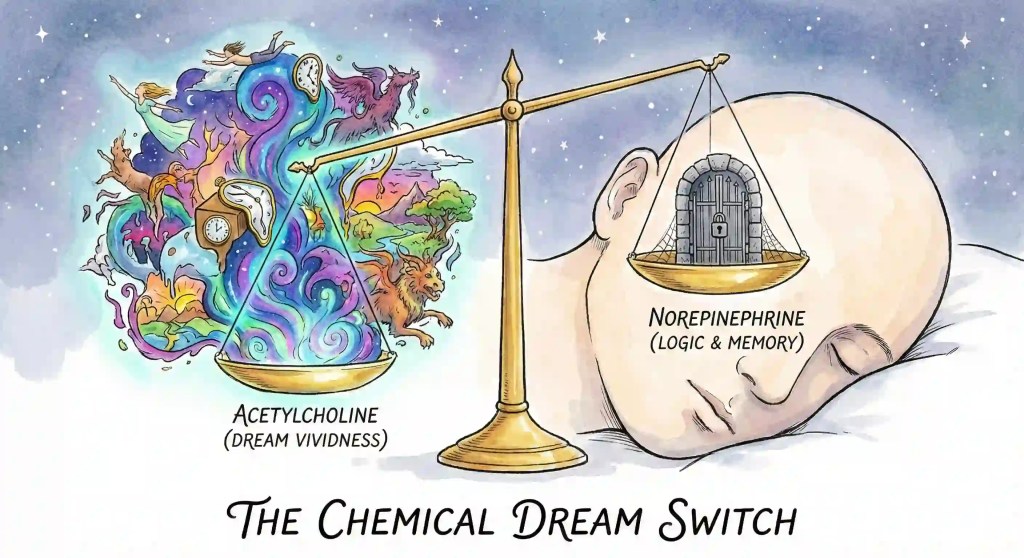
Acetylcholine vs. Norepinephrine: The Dream Switch
During the day, your brain has high levels of both acetylcholine (focus/learning) and norepinephrine (alertness/stress).
- In REM Sleep: Norepinephrine and Serotonin levels drop to nearly zero. Meanwhile, Acetylcholine levels spike, reaching levels similar to or higher than when you are awake.
- The Result: High acetylcholine triggers the vivid, visual, and emotional nature of dreams. The lack of norepinephrine is why you typically don’t feel “alert” or “logical” in a dream—until the moment of lucidity. This is the reason why it feels completely reasonable that your dog speaks Spanish and your grandma is the master dragon slayer until you wake up.
Why We Forget Dreams: The Memory Retrieval Gap
The reason most people “don’t dream” (or think they don’t) is a matter of neurobiology, not lack of activity.
- Storage Inhibition: The low levels of norepinephrine during REM mean that the brain’s “writing” mechanism for long-term memory is largely offline.
- The Transition: Memories of dreams are stored in short-term buffers. If you wake up and immediately focus on the physical world (checking your phone, getting out of bed), the brain flushes this buffer.
- The Fix: This is why dream journaling is non-negotiable. By staying still upon waking, you allow the brain to move dream data from short-term into long-term storage before the chemicals of the waking state take over.
- When making dream journaling a habit, over time your brain also starts to believe that dreams are something to remember and not flush away instantly, so remembering your dreams will become easier and easier. When I first started dream journaling, I could remember my dreams every now and then. After making it a habit, I can always clearly recall multiple vivid dreams from the night before. However, whenever I take some time off from dream journaling, the ability to remember my dreams starts to get worse gradually. As always, consistency is the key!
REM Cycles: Timing the Peak Experience
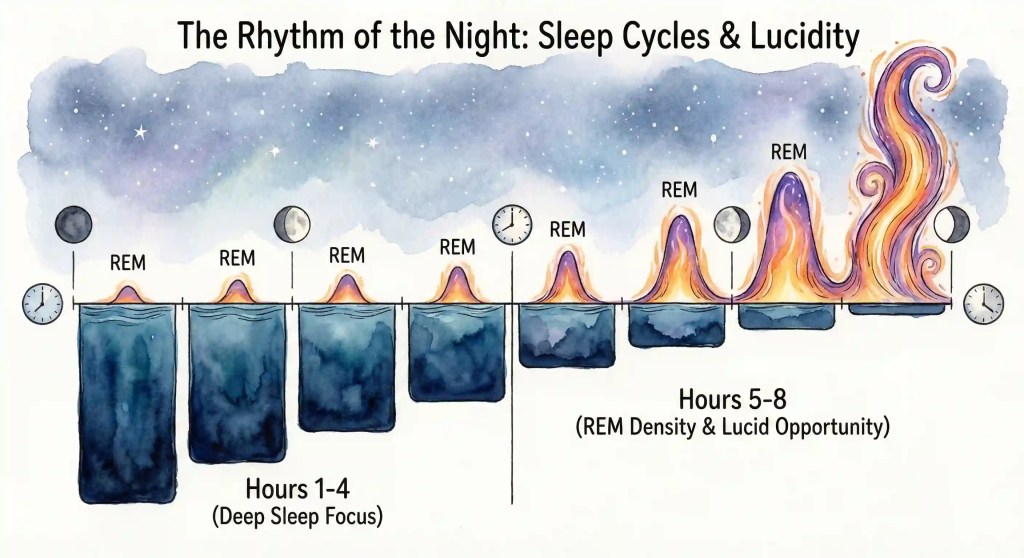
REM sleep is not a constant state; it is a resource that grows more abundant as the night progresses.
REM Density and Duration
In a standard 8-hour sleep period, your brain prioritizes deep, physical repair (N3 sleep) in the first 3-4 hours.
- The Evolution of a Night: Your first REM cycle may last only 5–10 minutes. By the end of the night, your final REM cycle can last 45–60 minutes.
- The Lucid Opportunity: This is why most lucid dreams happen in the early morning hours. The “REM density” is higher, meaning the dreams are more stable, vivid, and longer-lasting. Therefore, if you wish to learn lucid dreaming, fixing your sleep quality is the number one thing you should focus your attention on.
The “REM Pressure” Phenomenon (REM Rebound)
If you are sleep-deprived, your brain prioritizes deep sleep first. When you finally allow yourself a full night’s sleep, the brain experiences “REM Pressure.”
- The Rebound: The brain will skip or shorten other stages to crash into intense, long REM periods.
- The Risk: While REM Rebound leads to very vivid dreams, they are often unstable and “heavy,” making it harder for beginners to maintain the light, balanced focus required for lucidity.
Lucid Dreaming and the Hybrid State of Consciousness
Neuroscience has confirmed that lucid dreaming is a distinct physiological state. It is not just “imagination”; it is a hybrid state where the brain exhibits characteristics of both REM sleep and wakefulness simultaneously.
The Gamma Wave Connection: High-Level Awareness
In a normal dream, brain activity is dominated by Theta and Alpha waves. However, research using EEG on lucid dreamers has shown a significant spike in Gamma wave activity (around 40 Hz).
- The Significance: Gamma waves are associated with high-level cognitive functions, such as binding information from different senses, problem-solving, and self-awareness.
- The Hybrid Nature: During a lucid dream, the brain maintains the Theta-base of REM sleep but “layers” Gamma activity on top. This is the biological signature of being “awake inside a dream.”
Activating the Executive Function: The Prefrontal Cortex
As discussed in the Sleep Quality guide, the Dorsolateral Prefrontal Cortex (DLPFC) is usually offline during dreams. This is the area responsible for logic and self-reflection.
- The Trigger: Lucidity occurs when the DLPFC is reactivated without terminating the REM state.
- Maintaining the Balance: The challenge of lucid dreaming is keeping this area active enough to stay conscious, but not so active that it triggers the brain’s “wake-up” command. If the Gamma activity becomes too intense, the brain exits REM, and you wake up.
External Factors Affecting REM Quality
While your brain manages REM cycles internally, external factors can “fragment” or “suppress” this stage, destroying your chances of lucidity.
Temperature and REM Stability
REM sleep is the stage where your body’s ability to regulate temperature (thermoregulation) is at its weakest.
- The Fragmented REM: If your environment is too hot, your brain will frequently “kick” you out of REM sleep into a lighter stage to prevent overheating. This fragmentation prevents you from reaching the “deep REM” necessary for stable lucid dreams.
Substances and REM Suppression
As detailed in the Sleep Quality Optimization Guide, substances like alcohol and high doses of THC are primary REM suppressors.
- The Chemical Blockade: These substances artificially keep the brain in deeper or lighter stages of non-REM sleep. This prevents the natural spike in Acetylcholine, effectively “locking” the door to the dream world until the substance is metabolized.
FAQ: Everything You Need to Know About REM
Can you have REM sleep without dreaming? Technically, no. If the brain enters REM, it is active in a way that generates imagery and narrative. However, many people believe they don’t dream because their recall is poor. If you wake up during or immediately after a REM cycle, you are much more likely to remember the dream.
Is too much REM sleep bad for you? Excessive REM sleep is often a symptom of clinical depression or severe sleep apnea. In these cases, the brain spends too much time in REM at the expense of deep, restorative sleep. For a healthy individual, however, your brain has a natural “governor” that regulates the amount of REM you need.
Both REM and deep sleep serve distinct, vital purposes. Excessive REM sleep can reduce the time spent in deep sleep. So, indirectly, yes: too much REM can be problematic if it comes at the expense of deep, restorative sleep.
How to increase REM sleep duration naturally? The most effective way is to sleep longer. Since REM cycles lengthen as the night progresses, the 7th and 8th hours of sleep are the most REM-dense. Additionally, avoiding REM-suppressants like alcohol and maintaining a cool room temperature (18°C) ensures your REM cycles remain undisturbed.
Why do some people act out their dreams? This is a condition called REM Sleep Behavior Disorder (RBD). It occurs when the “muscle atonia” (paralysis) mechanism fails. Instead of the signals being blocked at the brainstem, they reach the limbs, causing the person to kick, punch, or jump during sleep. This is the opposite of sleep paralysis.
However, usually sleepwalking does not happen during REM, but rather during deep non-REM stages. When a sleepwalker is woken up, they rarely report dreaming, which indicates they were not in REM sleep. There are interesting studies regarding this.
Does REM sleep help with learning? Yes. REM sleep is critical for “procedural memory” (learning how to do things) and emotional regulation. During REM, your brain replays experiences from the day and integrates them into your existing knowledge base, often through the metaphoric language of dreams.
How to Master REM Sleep and Lucid Dreaming (Resources)
🎧 Further Reading
If you’re serious about mastering REM sleep, I recommend starting with the classics. Reading random articles isn’t enough—you need the deep knowledge found in these books: (Transparency: This section contains affiliate links to tools I personally use and trust.)
Tip: You can currently get these best-known books via this Audible deal (3 months for $0.99/month). It’s almost free too!



 Likely Dreaming | Exploring Dreams & Sleep
Leave a comment