
Why does your internal alarm clock trigger at exactly 3:00 AM?
You fall asleep easily, but like clockwork, your eyes snap open in the middle of the night. You aren’t just groggy; you are alert.
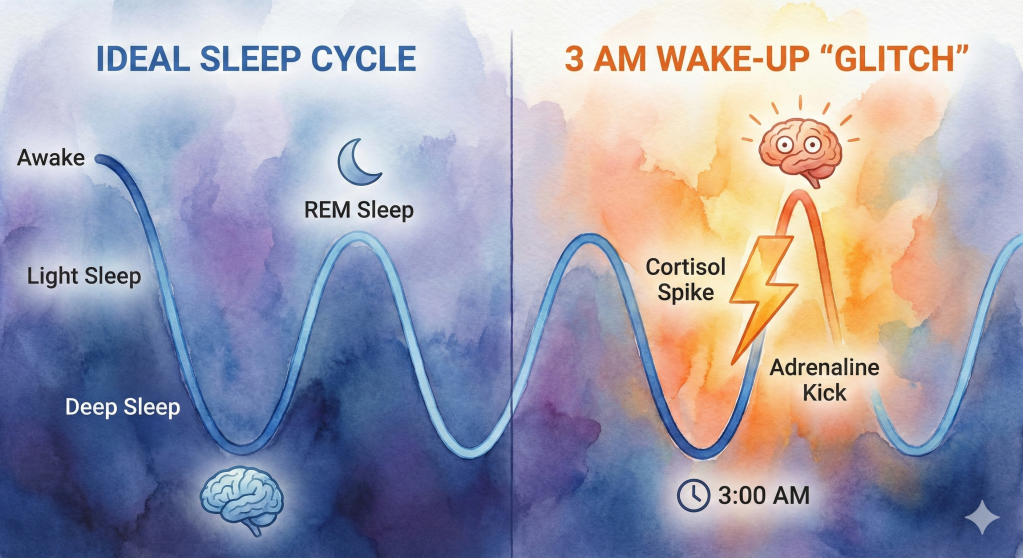
This isn’t random bad luck. It is a specific glitch in your sleep architecture. Around 3 AM, your brain transitions from Deep Sleep dominance to REM sleep, while your body temperature hits its lowest point. If your cortisol (stress hormone) spikes even slightly during this delicate phase, the transition fails, and you wake up fully wired.
I have faced this problem from time to time. It wasn’t until I stopped treating it as a psychological problem and started treating it as a biological one that I finally made sense of it. Here are the mechanics of why it happens—and how to fix it.
1. The Cortisol Spike (Stress Hormones)
Normally, your cortisol levels (the body’s “wake up” signal) should stay low until around 6:00 or 7:00 AM. However, if you are chronically stressed, your HPA axis (the system regulating stress) becomes hyperactive.
Instead of a slow morning rise, you get a premature cortisol dump in the middle of the night. Because your “sleep pressure” (adenosine) is already halfway gone by 3 AM, you don’t have enough chemical weight to push you back down into sleep against this stimulant spike.
The Fix:
- The Brain Dump: I keep a notebook by my bed. If I’m stressed, I write the tasks for tomorrow before I sleep. It offloads the data from your working memory so your brain doesn’t have to “hold” it.
- Physiological Sigh: Do 2-3 minutes of “double inhale, long exhale” breathing. It is the fastest way to manually lower cortisol.
2. The “Adrenaline Kick” (Nocturnal Hypoglycemia)
This is the most common reason for waking up with a racing heart.
Your brain is an energy hog. If you ate your last meal at 6 PM, by 3 AM your liver might run out of stored glycogen. When your blood sugar drops too low, your brain panics. To save you, it forces the adrenal glands to release adrenaline and glucagon to release more sugar into the blood.
You aren’t waking up because you are “done sleeping.” You are waking up because your body pulled the emergency brake.
The Fix:
- The Honey Hack: Before bed, try taking a teaspoon of raw honey with a pinch of salt. This keeps liver glycogen stable for longer.
- Slow Carbs: If that’s not enough, a small snack with fat or protein (like a spoonful of nut butter) before bed can stabilize the curve.
3. The REM Transition Fragility
The first half of the night is mostly Deep Sleep (physical repair). The second half is mostly REM Sleep (mental repair).
3:00 AM is the biological crossroads. You are surfacing from deep sleep to enter your first long REM period. During this switch, your arousal threshold is incredibly low. A clicking radiator, a street light, or a slightly too warm blanket is enough to pull you out.
The Fix:
- Temperature Control: Your body temperature needs to drop to stay asleep. If your room is over 19°C (66°F), it might be too hot for this transition phase.
- White Noise: Since your brain is hunting for threats during this light sleep phase, a fan or white noise machine masks the sudden spikes in sound that trigger the wake-up reflex.
4. The “Pavlovian” Loop
This was my biggest issue. After waking up at 3 AM for three nights in a row, my brain started expecting it.
The bed became a place of frustration, not rest. I would wake up and immediately check the clock. “3:04 AM. Great. Here we go again.” This thought alone releases enough norepinephrine to kill any chance of falling back asleep.
The Fix:
- Kill the Clock: Turn your alarm clock to face the wall. Knowing the time serves zero purpose and only fuels the anxiety loop.
- The 20-Minute Rule: If you haven’t fallen back asleep in 20 minutes, get up. Go to another room. Read a (boring) book in dim light. Only return to bed when you are physically tired. This breaks the association that Bed = Being Awake.
Summary: It’s Biology, Not Destiny
Waking up once is normal. But if you are staring at the ceiling at 3 AM every single night, check your biology:
- Is your blood sugar crashing? (Adrenaline)
- Is your stress peaking early? (Cortisol)
- Is your environment interrupting the REM transition?
Test these variables one by one. Usually, fixing just one of them stops the cycle.


How to Master Sleep and Dreaming (Resources)
🎧 Further Reading
If you’re serious about getting rid of sleep problems and mastering dreaming, I recommend starting with the classics. Reading random articles isn’t enough—you need the deep knowledge found in these books: (Transparency: This section contains affiliate links to tools I personally use and trust.)
- Exploring the World of Lucid Dreaming
- Why We Sleep: Insanely helpful for anyone suffering with sleep problems!
- Lucid Dreaming: Gateway to the Inner Self
Tip: You can currently get these best-known books via this Audible deal (3 months for $0.99/month). It’s almost free too!
 Likely Dreaming | Exploring Dreams & Sleep
Leave a comment